The AI Bill Is Coming: Are Indian Households Ready to Pay?
There is a new bill headed your way. It will arrive quietly, nestled between your electricity notice and your streaming subscription, and it will have two words printed at the top: Artificial Intelligence.
Not so long ago, AI felt like magic you hadn’t paid for. You typed, and it replied. You asked; it answered. You marveled for a moment, then moved on, work done in a fraction of the usual time. There were no paywalls, no hourly caps, no gentle nudge telling you that you had reached your limit for the day.
The era is drawing to a close.
The caps are already here. Most platforms now throttle free users within hours, sometimes within minutes. The intermittent responses, the “come back later” messages, and the increasingly firm prompts to upgrade, these are not glitches. They are the product roadmap.
From Freemium to Fee
The business model behind AI’s generosity was always temporary. Large language models are expensive to build and more expensive to run. The computing costs alone require a level of capital that no company can sustain by giving the product away indefinitely. What felt like a gift was, in industry terms, a customer acquisition strategy.
It has worked. Millions of Indian users now rely on AI for tasks that once took hours: summarizing documents, drafting presentations, debugging code, and explaining complex research in plain language. Students use it to navigate coursework. Entrepreneurs use it to punch above their weight. Professionals use it to stay competitive. The dependency, once formed, is not easily unformed.
Which is precisely when the pricing conversation begins.
The Household Math
Consider a typical middle-class household. The ChatGPT Go plan at ₹399per month seems reasonable enough, roughly the cost of a meal at a mid-range restaurant. But a single subscription rarely stays single for long. A student at home needs it for research. A spouse preparing a business pitch wants the presentation features. A professional upskilling in the evenings needs the coding tools. Before the end of the first billing cycle, that ₹399has become ₹1,000 or more, and it will return every month without fail.
That is the structure of the AI bill: modest at the entry point, expansive at the household level, and permanent once the habit is set.
India as a Strategic Market
India is not an afterthought in the global AI pricing conversation. It is, by several measures, the largest AI market outside the United States, with a base of approximately 800 million internet users that no major platform can afford to ignore. Pricing decisions made in San Francisco and Seattle are shaped, in part, by the size and sensitivity of the Indian consumer base.
This is why the introductory offers have been so aggressive. Bharti Airtel partnered with Perplexity to give subscribers a free year of its Pro tier. Google offered students a complimentary year of its AI Pro service. Reliance Jio subscribers received access to Gemini AI Pro, normally ₹1,950per month, at no cost for eighteen months, representing a saving of approximately ₹35,100. These are not acts of corporate generosity. They are trials, designed to extend the household footprint of AI and increase the number of people who will feel its absence when the free period ends.
The strategy is as old as consumer marketing: give users a taste, create dependency across the household, then present the bill.
The Freemium Floor Will Hold-For Now
It would be an overstatement to say free AI is disappearing entirely. The platforms have a structural incentive to maintain some level of free access: it keeps the top of their acquisition funnel open and sustains the social proof that drives upgrades. If you send one email a day, occasionally need help brainstorming, or use AI intermittently, the free tier will remain functional for the foreseeable future.
The floor is not being removed. It is being lowered. The daily cap shrinks, the advanced features migrate behind paywalls, and the tasks that once fell within free limits now require a subscription. The experience degrades gradually enough that many users will not notice the shift until they are already on the other side of it.
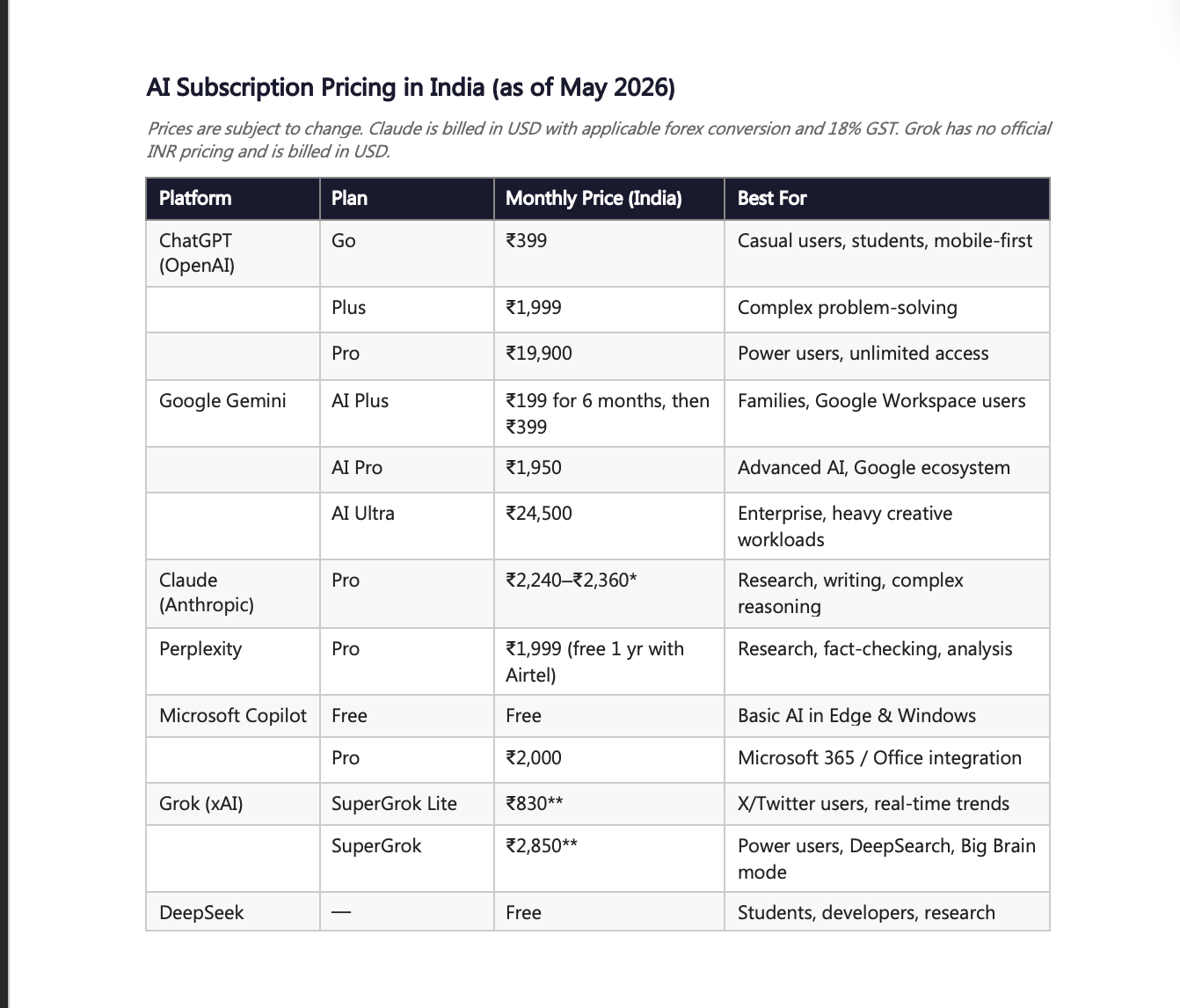
AI Subscription Pricing in India (as of May 2026)
Prices are subject to change. Claude is billed in USD with applicable forex conversion and 18% GST. Grok has no official INR pricing and is billed in USD.
Is It Worth Paying?
The honest answer, for most users who have crossed the threshold into meaningful AI use, is yes. Hours of research compressed into minutes. Drafts that once took an afternoon were produced in twenty minutes. Complex data explained in plain terms without a specialist’s fees. The productivity dividend is real, and for students, researchers, and working professionals, the cost-to-value ratio compares favorably against other professional tools they already pay for without question.
The discomfort is not really about the money. It is about the transition, from a tool that felt free to one that has declared its price. That shift is psychologically jarring even when the underlying value has not changed.
The Longer Arc
Electricity was once a luxury. The telephone was once a privilege of the elite. Broadband internet arrived in Indian cities before it reached the rest of the country, and for years, it felt optional. Each of these technologies followed the same trajectory: expensive novelty, then gradual adoption, then invisible necessity. The bill for each became unremarkable over time, absorbed into the monthly rhythm of household expenses.
AI is on that same road. The monthly AI bill, whether ₹399or ₹1,999 or something in between, will, within a few years, look no different from the broadband bill: a fixed cost so embedded in daily life that questioning it would feel strange.
We are still in the early stretch of that journey. The pricing is still settling, the platforms are still competing, and the free tier has not yet disappeared. This is, in practical terms, the best time to be paying attention.
EDITOR’S NOTE
Pricing data in this article reflects publicly available figures as of May 2026. Telecom partnership offers (Airtel/Perplexity, Jio/Gemini) are subject to change; readers are advised to verify current terms directly with their service provider. Claude (Anthropic) is billed in USD; final INR amounts will vary with exchange rates and include 18% GST. Grok pricing is USD-denominated with no official INR equivalent.